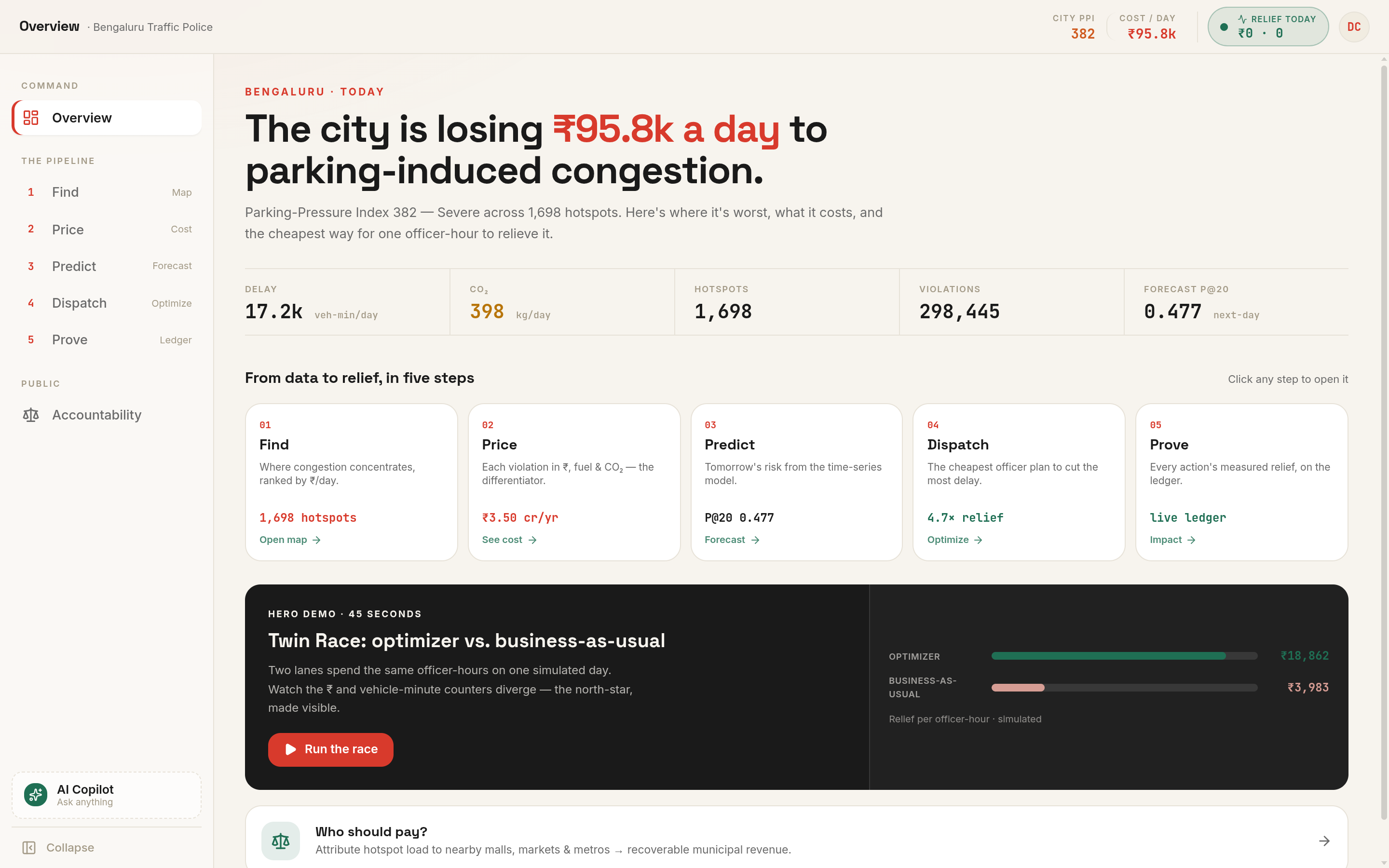
382
City PPI
Parking-Pressure · Severe
298K violations → 1,698 hotspots, ranked by ₹ not counts.
Attribution engine: violation → delay → ₹, fuel, CO₂, health.
Backtested forecast of tomorrow's pressure — beats baselines.
ROI optimiser + patrol route for scarce officer-hours.
Every clear booked to an auditable Impact Ledger.
Every violation snaps onto an Uber-H3 grid and collapses into 1,698 ranked hotspots — sorted by the rupees of delay they cause, not by raw ticket count.
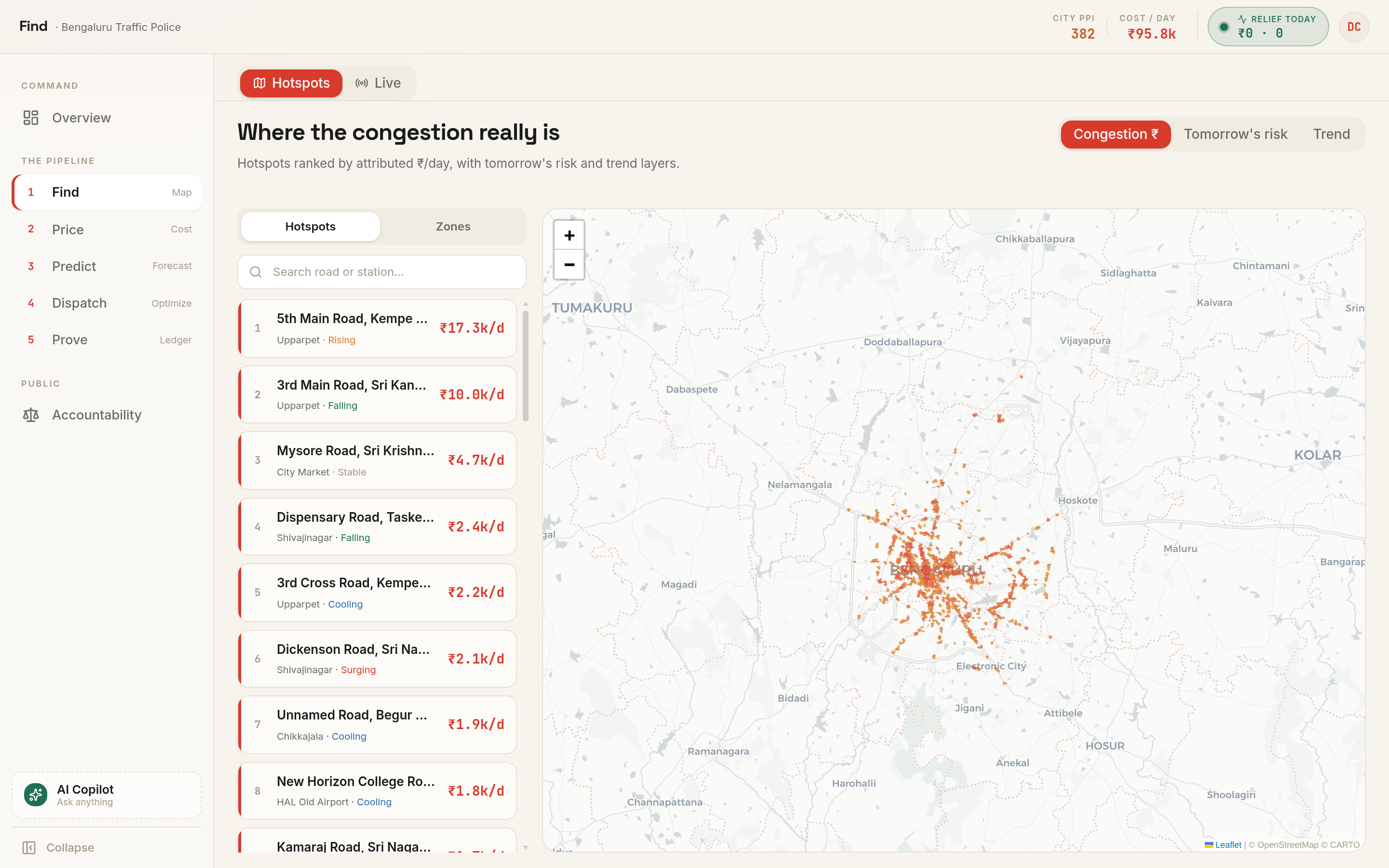
The Congestion Attribution Engine runs the causal chain — and every number traces to a formula + a cited parameter in params.yaml.
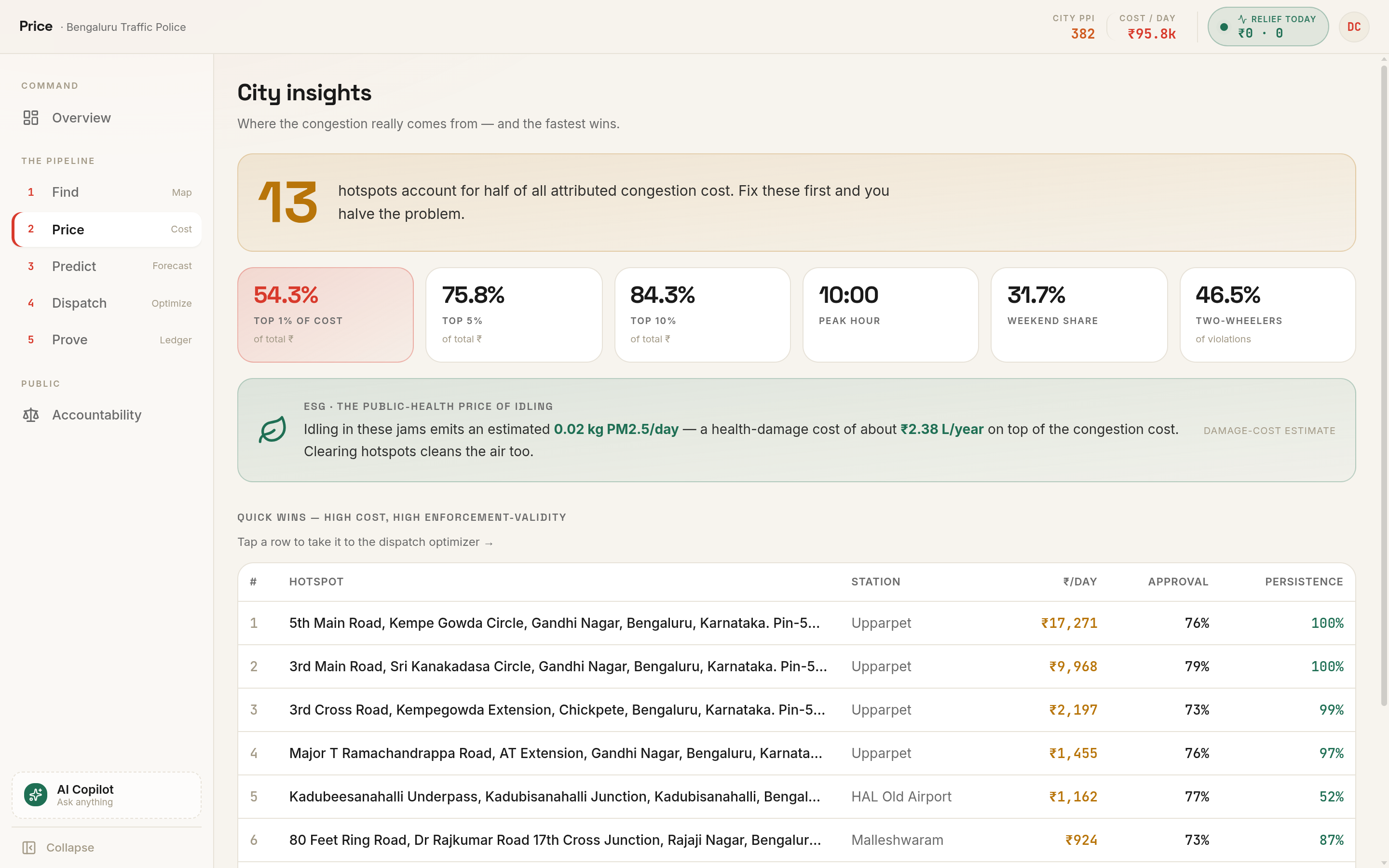
A gradient-boosted, time-series-backtested model ranks where pressure flares next. It's only credible because it beats the naïve baselines — and it does, with no leakage.
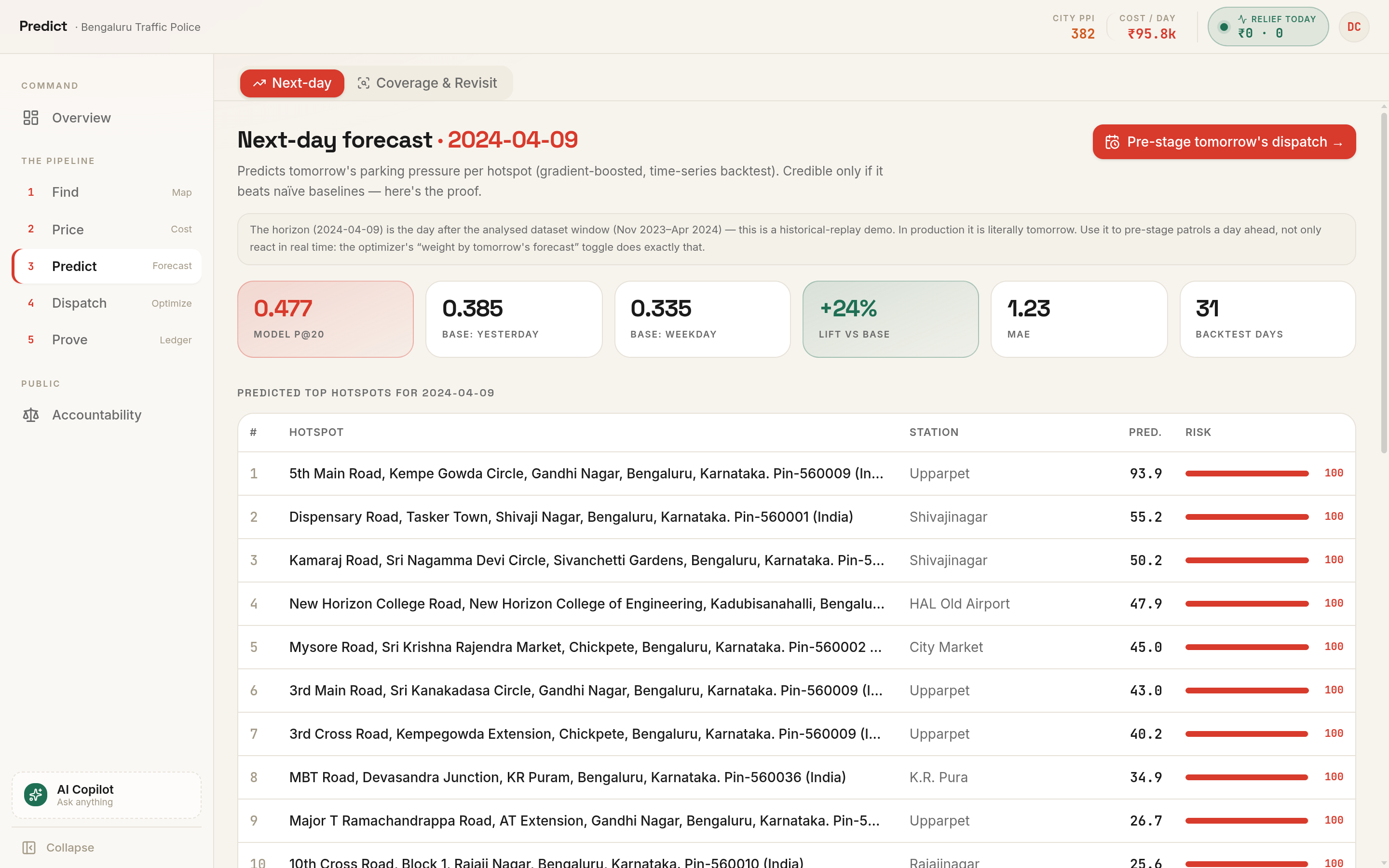
An ROI optimiser — cost × risk, capacity-constrained — writes the work orders and the patrol route, then proves the lift over simply deploying to the busiest spots.
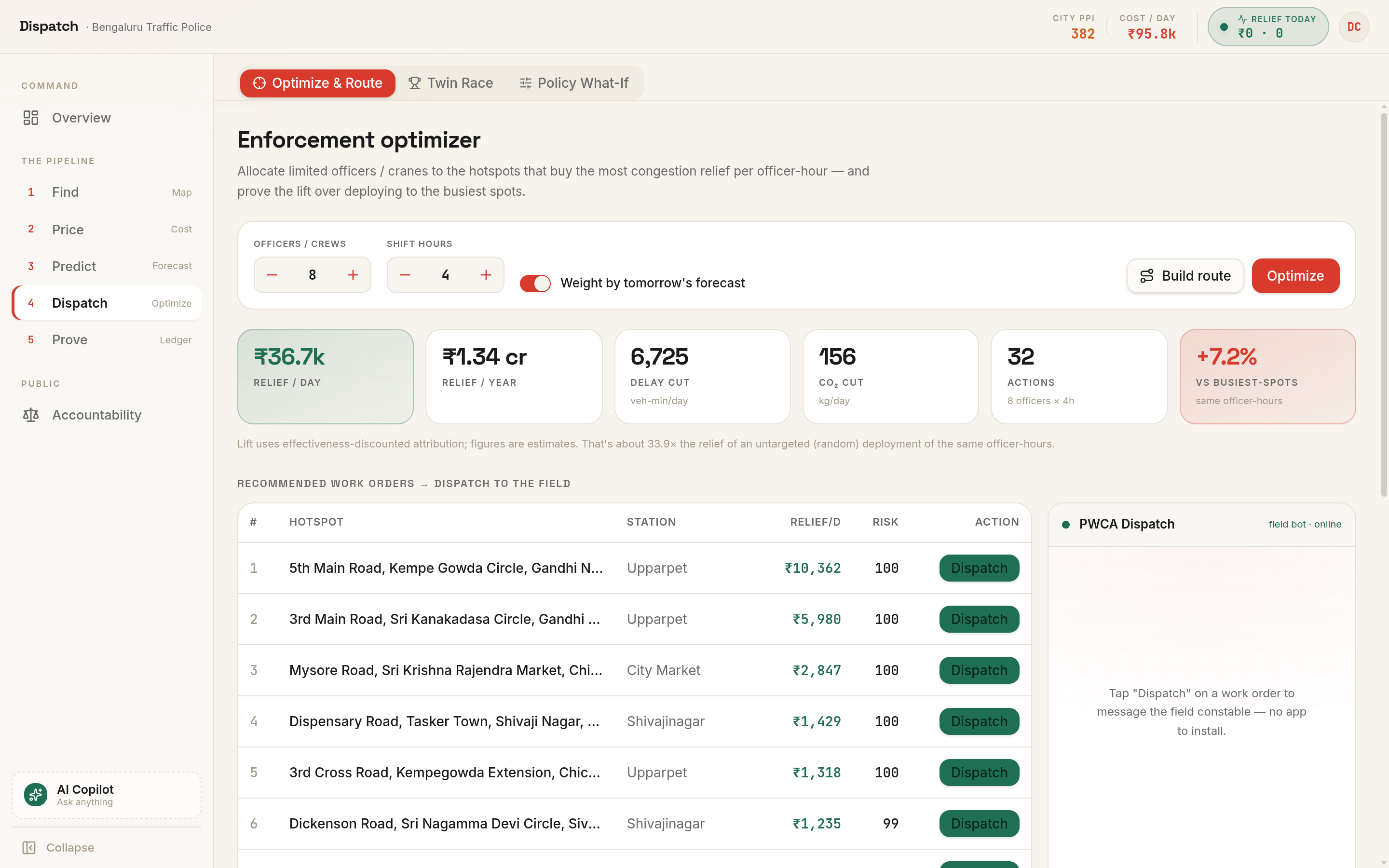
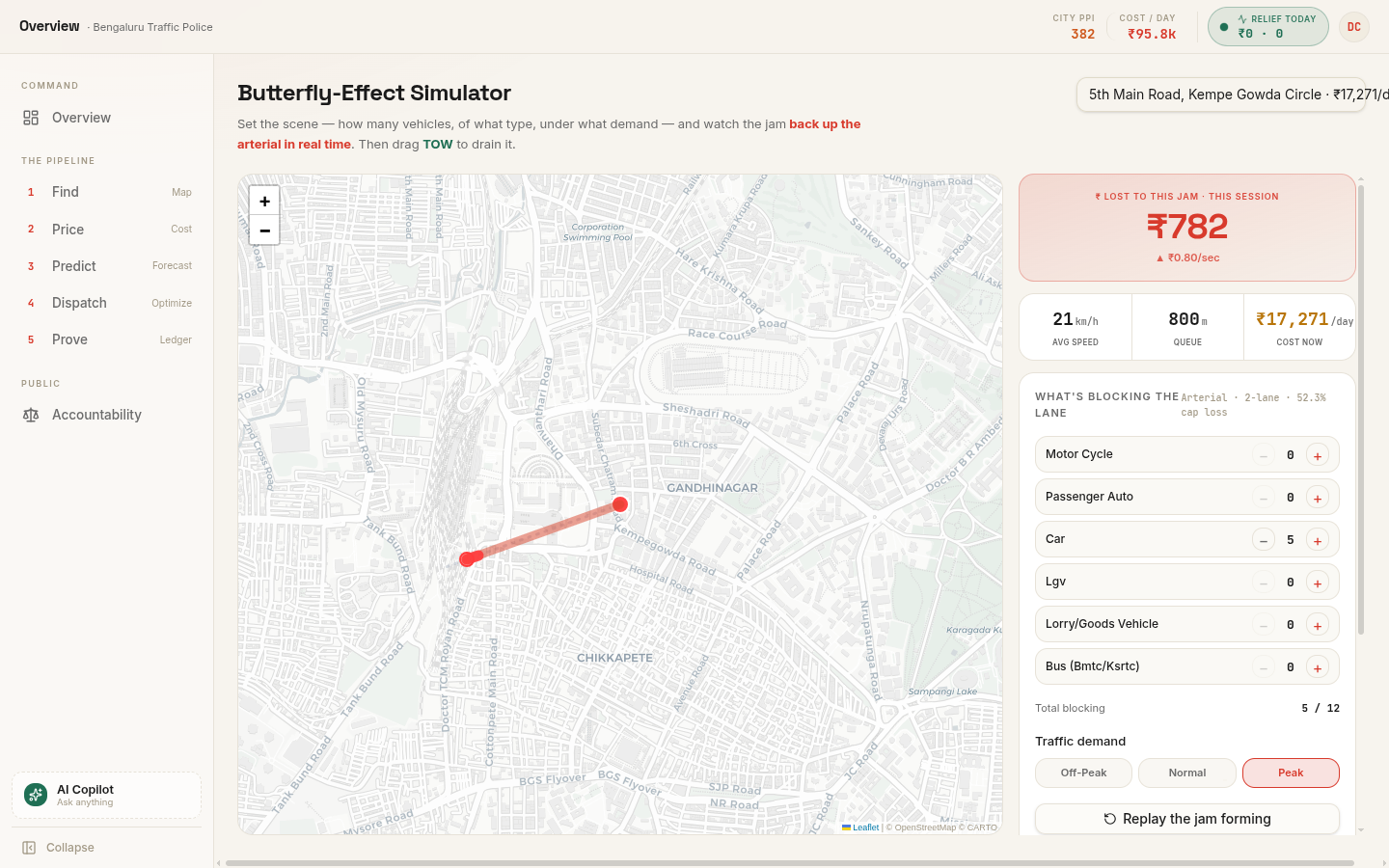
Each clear is booked to an append-only Impact Ledger — rupees, vehicle-minutes and CO₂, traceable to the formula and the hotspot it came from. No vanity metrics.
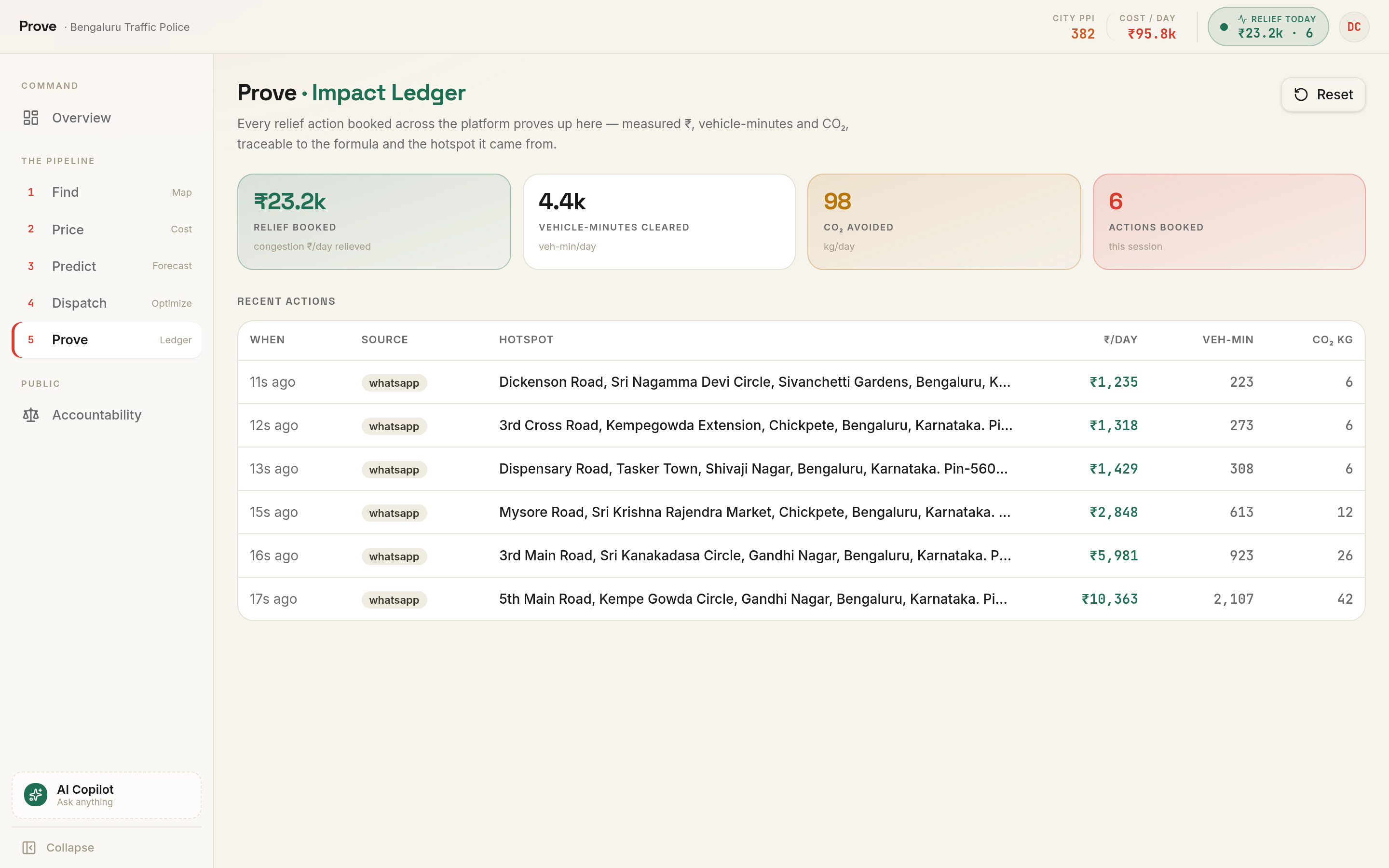
One simulated day · 12 officers · 180 officer-hours. Random chases active hotspots; PWCA follows the optimiser. The relief diverges.
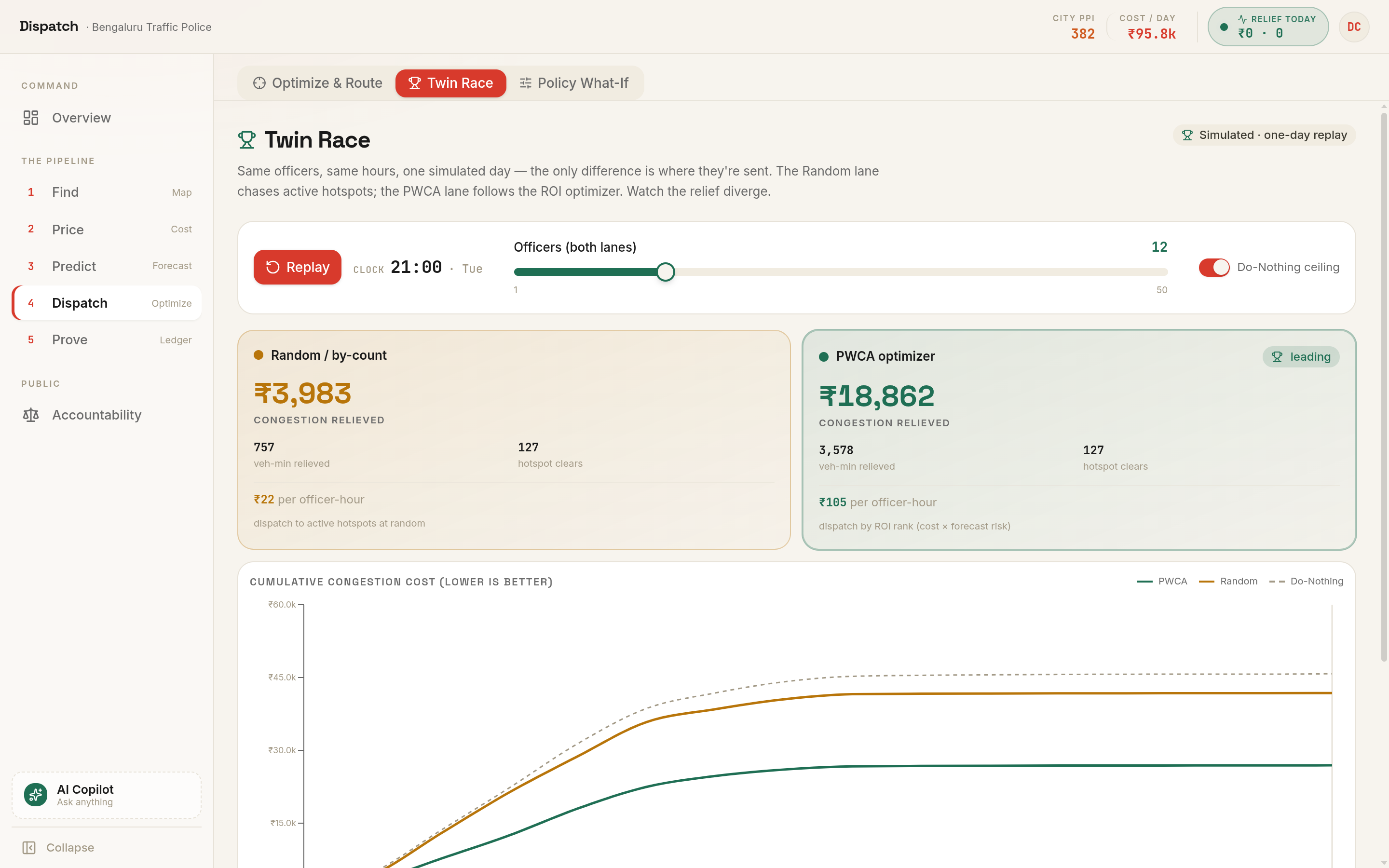
Its parking spillover costs the city ₹6.10 cr / year. 45% is recoverable as a congestion levy — ₹2.74 cr / year — alongside a Gemini-drafted official notice (with deterministic fallback).
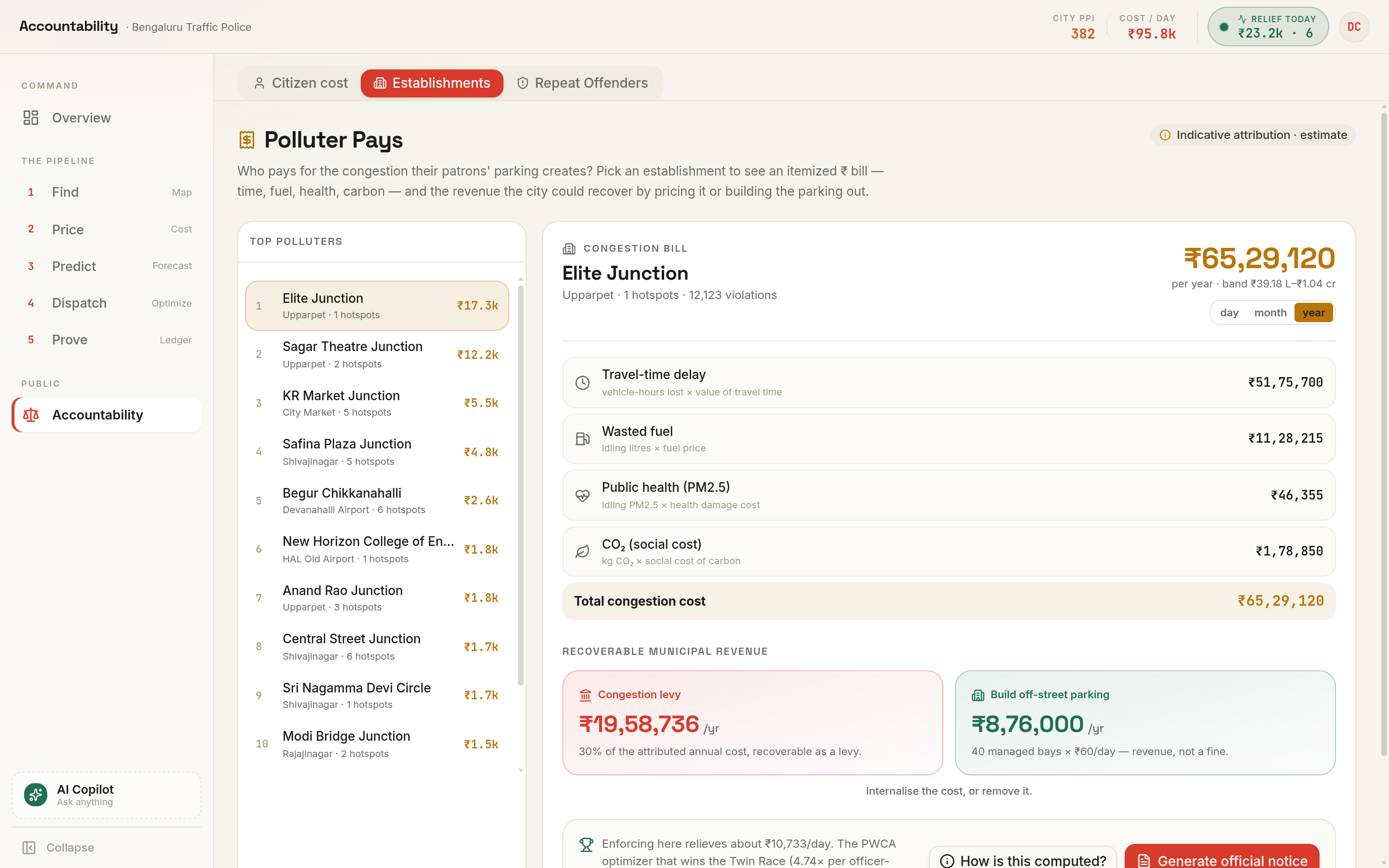
A kinematic-wave digital twin: set how many vehicles, of what type, under what demand, and the queue backs up the road in real time at a modelled shockwave speed — magnitudes anchored to the Attribution Engine. Then drag TOW to clear the lane and book the relief.
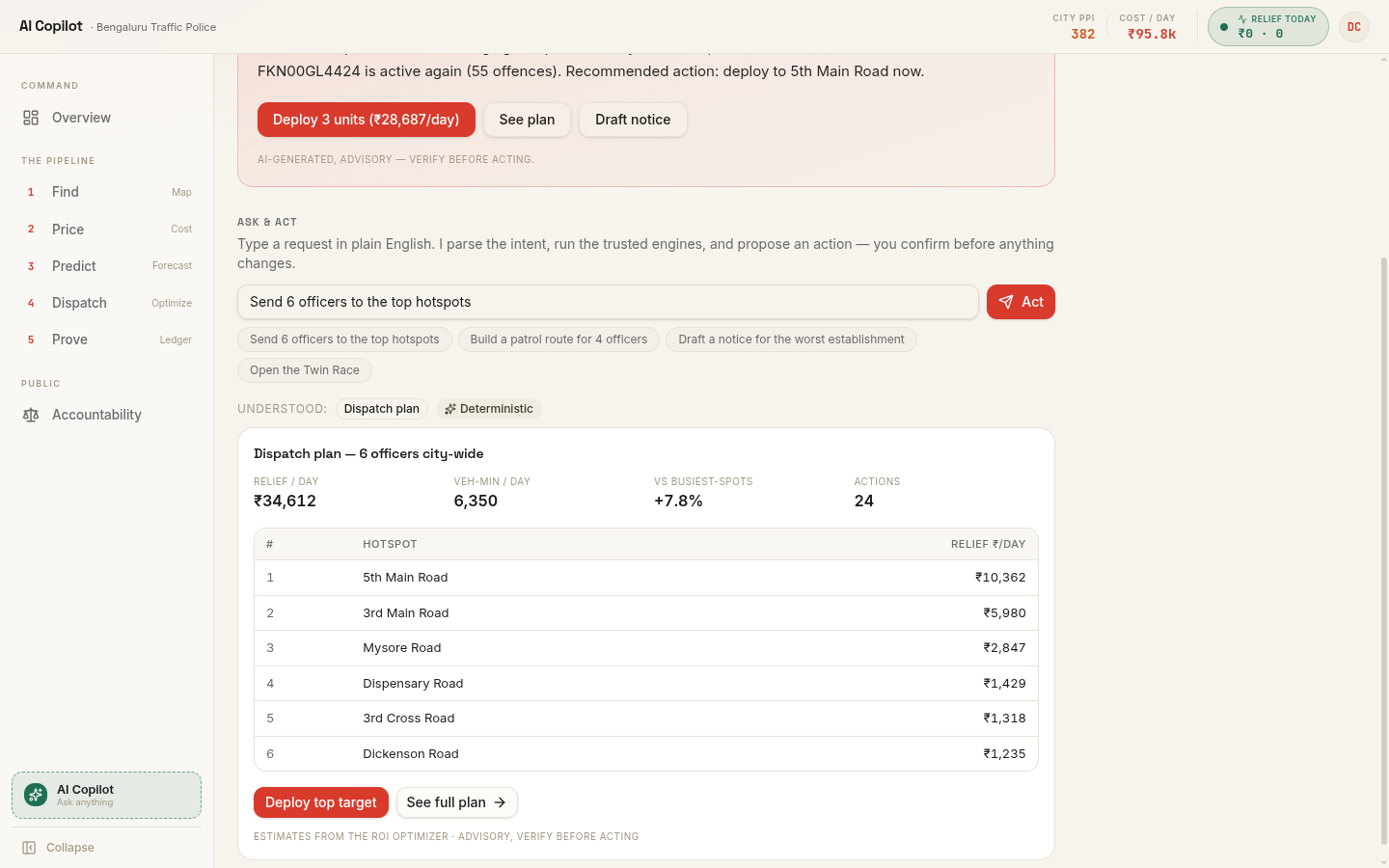
The docked copilot plans & drafts; you approve. Gemini parses intent + slots only — the server runs the trusted engines and owns every number. Nothing changes until you confirm.
“Send 6 officers to the top hotspots” → a dispatch plan relieving ₹4.53 L/day, +16.7% over chasing the busiest spots. Every figure from the optimiser; a deterministic parser is the floor when there's no key.
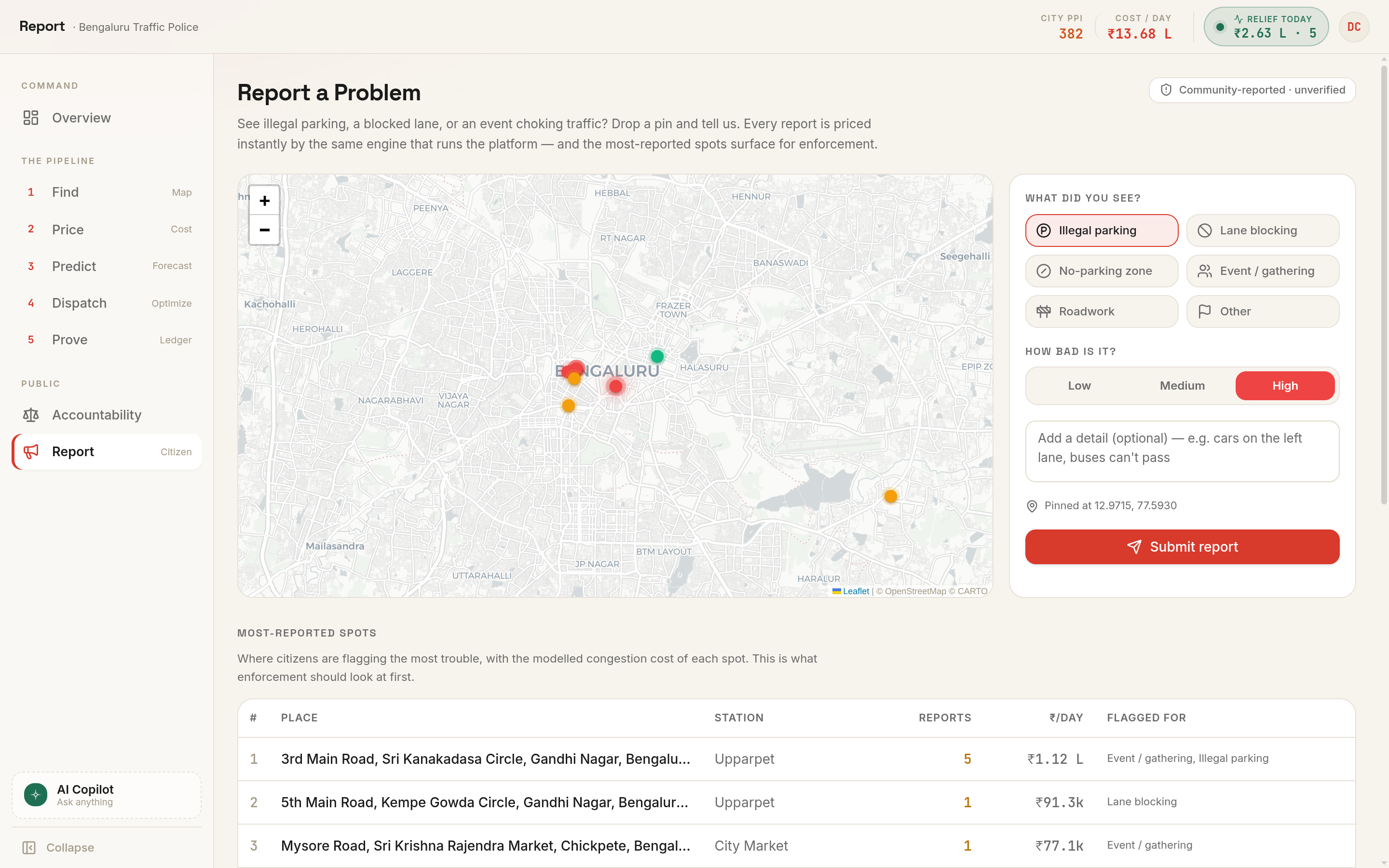
Drop a pin, pick what you saw — and the report is priced instantly by the same Attribution Engine that runs the war-room. The most-flagged spots surface straight into the enforcement queue — closing the loop between the public and the patrol.